14 July 2026
Rosemary Kay
Accessibility isn’t a feature we added to 6D Pixie. It’s the reason we built it the way we did.
At Gazooky Studios, our commitment to inclusive design runs deeper than a policy position. Our founder has two disabled children. That changes how you think about every product you build, not as an abstract principle, but as a daily reality. Who gets left out when information is only available in one format? Who can’t attend the consultation event because the venue isn’t accessible, the timing doesn’t work, or the sensory environment is overwhelming? Who never gets to have their say?
| |
The people most affected by how a place changes are often the least likely to be consulted about it.
|
That conviction led directly to one of our most significant projects: ChapARone, a wayfinding tool developed with Network Rail and funded by the Department for Transport, designed to help disabled passengers navigate complex transport hubs independently. Using the same location-aware technology that underpins 6D Pixie, ChapARone delivers turn-by-turn guidance tailored to a passenger’s specific needs, whether that’s a mobility impairment, visual difficulty, cognitive challenge, or anxiety in crowded spaces.
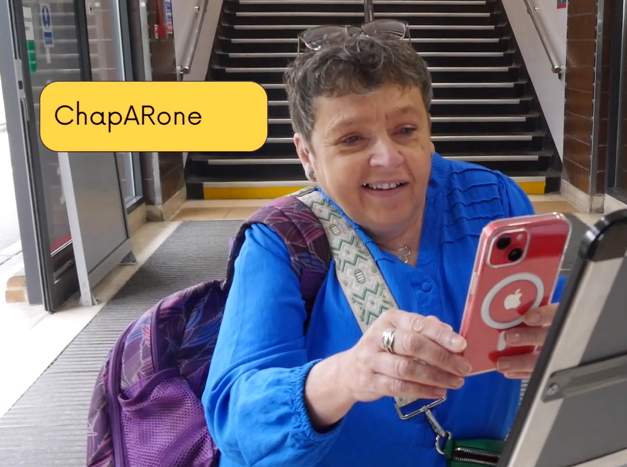
What we learned from ChapARone is that location-aware technology, done well, has a remarkable ability to give people agency in spaces that were never designed with them in mind. A platform that responds to where you are, rather than expecting you to search, scan, or navigate, removes a layer of friction that most people never notice, but some people find insurmountable.
And it isn’t just disabled people who could benefit from a platform which puts relevant location-specific information into the hands of ordinary people. Only the other day, a junior developer of ours was travelling to a site with heavy equipment. The google maps direction he used led him down a road which was blocked by street works for pedestrians, so he had to retrace his steps, and find an alternative route, taking him a good half hour trudging with heavy equipment. Fortunately he could alert our Disability Consultant not to take that route.
The same principle applies to community engagement
Traditional public consultation systematically excludes people who can’t attend evening meetings, who struggle with dense written documents, who don’t have reliable internet access, or who find unfamiliar environments difficult to navigate. These aren’t edge cases. They represent a significant proportion of the communities most affected by major development and regeneration projects.
6D Pixie is built around a simple idea: bring the information to where people already are. Not to a meeting room or a website, but to the street they walk down, the site they pass every day, the place they already have a relationship with. That approach doesn’t just improve engagement numbers. It changes who gets to engage.
We’re proud of the work we’ve done on accessibility, and we’re committed to making sure it shapes everything we build next.
